
Are You Securing Your Systems - or Your Entire Business Environment?
The uncomfortable reality is that most organisations do notget a convenient warning before a serious cyber incident. The warning signs areoften there, but they are scattered across systems, access rights, userbehaviour, outdated assets, external vendors and processes that haveaccumulated over time.
This is why the more useful question is not simply, “Are oursystems secure?” It is, “Do we understand the security of the environment ourbusiness actually operates in?”
That environment is wider than the network. It includespeople, applications, identities, cloud platforms, data, devices, suppliers,remote access, business processes and the dependencies that keep operationsrunning.
Security tools are only one part of the picture
Most organisations already have some form of cybersecuritytechnology in place. Firewalls, endpoint protection, email security, identitytools, backups and monitoring platforms are common. In larger enterprises, thelist can be extensive.
But the presence of security tools does not automaticallymean the environment is secure.
A company can have strong endpoint protection and still haveexcessive user privileges. It can have modern cloud security and still retainforgotten accounts. It can run regular backups without knowing whether thosebackups can be restored quickly enough during an outage. It can invest inmonitoring while critical alerts are not being reviewed with the urgency theyrequire.
The challenge is therefore not simply whether controlsexist. It is whether those controls work together around the risks that matterto the business.
The business environment has become harder to define
The traditional idea of a company network with a clearperimeter has weakened considerably.
Employees work from different locations. Applications runacross cloud platforms and software-as-a-service environments. Businesspartners connect to enterprise systems. Customers access services digitally.Data moves between internal applications and third-party platforms. Employeesuse mobile devices, collaboration tools and, increasingly, AI services.
Each connection creates business value. It can also createanother route through which risk enters the organisation.
This does not mean digital expansion should be slowed. Itmeans cybersecurity has to follow the way the business now operates, ratherthan the way the technology environment looked several years ago.
At Trivara Consulting, we see this as an environment-levelquestion. A useful cybersecurity assessment should not look only at individualtools. It should examine identities, applications, data, infrastructure, cloud,endpoints, third parties and business-critical processes together, becauseweaknesses often exist between these areas rather than inside a single product.
The first task is to understand what you are protecting
- Focus on business outcomes before technology activity.
- Build on the enterprise environment that already exists.
- Prioritise scalable, secure and measurable value creation.
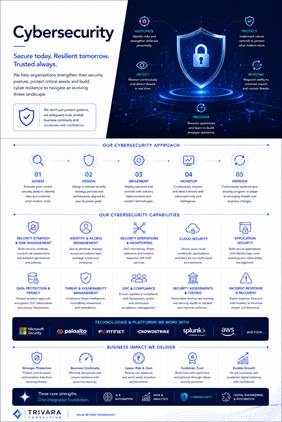
One of the simplest cybersecurity questions can also be oneof the hardest to answer: What are the assets the business cannot afford tolose access to?
For some organisations, the answer may include customer dataand transaction systems. For others, it may be manufacturing systems,intellectual property, healthcare records, financial platforms, logisticsapplications or operational technology.
Not every asset carries the same consequence if it iscompromised. That matters because cybersecurity investment should reflectbusiness criticality, not only technical severity.
A practical starting point is to establish visibility acrossthe environment.
- Which systems and applications are business-critical?
- Where does sensitive or regulated data reside?
- Who has access to those systems and data?
- Which third parties can connect to the environment?
- Which assets are internet-facing?
- Which systems are outdated, unsupported ordifficult to patch?
- What would stop the business from operating ifit became unavailable?
- How quickly would the organisation know if oneof these assets was compromised?
Without this visibility, cybersecurity becomes reactive.Teams protect what they can see, while older systems, unused accounts,undocumented integrations or third-party access can remain outside normalattention.
Trivara can help organisations establish this baselinethrough structured security and environment assessments, identifying exposurein the context of business impact rather than producing a list of technicalfindings without prioritisation.
Identity has become a major part of the security perimeter
As applications move to the cloud and work becomes moredistributed, identity has become one of the most important control points inenterprise security.
An attacker may not need to break through a network if validcredentials provide access to the information or systems they want.
That makes questions around authentication, privileges andaccess lifecycle increasingly important.
Who has administrator access? Are old employee accountsdisabled promptly? Do external vendors retain access after a project ends? Areprivileged accounts protected differently? Is multi-factor authenticationapplied consistently? Can unusual login behaviour be detected?
These may appear operational, but they directly influencecyber risk. In many environments, tightening identity and access controls canreduce exposure more quickly than adding another security product.
Third-party risk is still your risk
Few organisations operate independently. Technologyproviders, implementation partners, payroll vendors, logistics companies, cloudplatforms, consultants and other suppliers may all hold data or have access tosystems.
That ecosystem is necessary for modern business, but itexpands the attack surface beyond infrastructure the organisation directlycontrols.
A supplier with weak security practices can create exposureeven when the enterprise itself has invested heavily in protection.
This is why third-party cybersecurity should go beyondcontractual language. Organisations need to understand what access a vendorhas, what information it handles, how that access is controlled, and whathappens when the relationship ends.
The principle is straightforward: outsourcing a service doesnot outsource accountability for the business consequence of a breach.
The wake-up call should not be the incident
Cybersecurity spending often accelerates immediately after abreach, regulatory finding or major incident in the industry. The problem isthat this is usually the most expensive moment to discover what was missing.
A better approach is to create regular moments of deliberatescrutiny before an event forces them.
That does not require every organisation to begin with alarge transformation programme. It can begin with a focused assessment of thecurrent environment, the most critical assets and the most likely points ofexposure.
The first few steps are practical:
- Create an accurate view of critical systems,data and dependencies
- Review user access and privileged accounts
- Assess vulnerabilities and patching discipline
- Confirm backup coverage and test recovery ratherthan assuming it works
- Review cloud and third-party access
- Check whether security alerts are monitored andescalated effectively
- Assess employee awareness around phishing,credentials and data handling
- Define who does what when an incident occurs
These activities may not sound dramatic, but they answer animportant management question: If something happens tomorrow, will we know,will we contain it, and can we recover?
That is a far more useful measure of cybersecurity maturitythan the number of security products an organisation owns.
Cybersecurity is increasingly a resilience question
No serious security programme can promise that anorganisation will never be attacked. The objective is to reduce the probabilityand impact of an incident while improving the organisation's ability torespond.
This is where cybersecurity and business resilience begin toconverge.
Can operations continue if a critical application isunavailable? Can systems be restored within a period the business can tolerate?Is decision-making clear during an incident? Are customers, regulators andpartners communicated with appropriately? Are alternative processes availableif digital systems are disrupted?
For leadership teams, these questions matter because thefinancial impact of a cyber incident often extends well beyond the initialcompromise. Downtime, lost revenue, customer disruption, remediation costs,legal exposure and reputational damage can continue long after the technicalissue is contained.
Trivara's approach is therefore to connect cybersecuritypriorities to business impact. A vulnerability becomes more meaningful whenleadership understands which service, customer process, revenue stream orcritical operation depends on the affected asset.
AI is changing the threat environment as well
AI is creating useful new capabilities for enterprises, butit is also changing the security landscape.
Employees can now share information with external AI toolsin seconds. Attackers can use AI to improve phishing, automate reconnaissanceand create more convincing social-engineering attempts. AI-enabled applicationscan introduce new questions around access, data exposure and model behaviour.
At the same time, AI can strengthen defence by helpingsecurity teams analyse large volumes of events, detect anomalies and prioritiseinvestigation.
The issue is not whether AI is good or bad forcybersecurity. It is whether organisations understand how AI is changing bothsides of the equation.
This is another reason Trivara considers AI, Data andCybersecurity together. As organisations adopt new AI capabilities, securityand data governance need to evolve alongside them rather than being added afterdeployment.
Questions leadership teams should be able to answer
What would hurt the business most if it were compromised or unavailable?
Cybersecurity priorities should begin with business-criticalsystems, data and processes rather than a generic list of assets.
Do we know who and what has access to those assets?
Employees, administrators, vendors, service accounts andexternal integrations all form part of the access landscape.
Would we know quickly if something unusual happened?
Detection matters because the longer an attacker remainsunnoticed, the more difficult and expensive containment can become.
Can we recover, or do we only have backups?
Recovery should be tested against realistic businessrequirements, not assumed from the existence of backup infrastructure.
Are we improving the environment, or simply adding more tools?
Technology investment should close known gaps and strengthenresilience rather than increase complexity without clear risk reduction.
Security before urgency
Cybersecurity is difficult partly because success is ofteninvisible. When controls work, nothing dramatic happens.
That can make security easier to postpone until a visibleincident creates urgency.
But the more connected the enterprise becomes, the lesssensible that approach is. Cybersecurity now influences operational continuity,customer trust, regulatory exposure, digital transformation and the ability toadopt new technologies with confidence.
The objective is not to create fear around every new risk.It is to know where the organisation is exposed, decide which risks mattermost, strengthen the controls that protect critical operations, and build theability to respond when something inevitably goes wrong.
That is the difference between securing individual systemsand building a resilient business environment.
How Trivara Consulting Can Help
Trivara Consulting helps organisations understandcybersecurity in the context of the wider business environment - not as acollection of isolated security products.
Our work across Cybersecurity, Data and AI allowsorganisations to assess risk alongside the technology, data and transformationinitiatives that increasingly shape the modern enterprise.
Trivara can support organisations in areas such as:
- Cybersecurity posture and environment assessment
- Risk and vulnerability assessment
- Identity and access review
- Cloud and infrastructure security assessment
- Data security and access considerations
- Third-party and external-access risk review
- Cyber resilience, backup and recovery readiness
- Incident-response preparedness
- Security governance and prioritised improvement roadmaps
- Security considerations for AI anddigital-transformation initiatives
The starting point is to understand the environment as itexists today, identify the exposures that matter most to the business, andcreate a practical sequence of improvements rather than treating everycybersecurity issue as equally urgent.
Questions we're commonly asked.


Every Successful Modernization Starts with the Right Conversation.
Whether you're exploring AI, modernizing legacy systems, strengthening cybersecurity, or building a long-term capability roadmap, the right approach begins with understanding your business. Let's discuss your priorities, identify the opportunities, and define the best path forward.


