
Your Business Has Data. But Are You Creating Enough Value From It?
In many companies, valuable information remains fragmentedacross systems, duplicated across departments, stored in formats that aredifficult to use, or available only to a small number of technical teams.Reports may be produced regularly, but decisions are still delayed. Dashboardsmay exist, but confidence in the underlying numbers is inconsistent. Data isbeing accumulated, yet its commercial value remains underdeveloped.
This raises a more useful question than simply asking howmuch data an organisation owns:
How much business value is the organisation actuallycreating from it?
That value may come through better decisions, improvedcustomer insight, operational efficiency, risk reduction, new services, betterforecasting, or direct and indirect forms of data monetisation. Increasingly,it will also determine how effectively an organisation can adopt AI.
Data monetisation is broader than selling data
The term data monetisation is sometimes interpreted toonarrowly. It can suggest selling datasets or creating a new external dataproduct. Those are valid models in certain industries, but for mostenterprises, the larger opportunity is internal.
Data can create value when it helps a business make a betterdecision, reduce waste, identify a profitable customer segment, improvepricing, detect risk earlier, shorten a process, increase asset utilisation orimprove the effectiveness of sales and service teams.
In that sense, data monetisation can be direct or indirect.
Direct monetisation
The organisation creates a revenue-generating product,service, benchmark, insight or platform based on data it is legally andcommercially entitled to use.
Indirect monetisation
The organisation uses data to improve an existing businessoutcome - for example, increasing conversion, reducing churn, improving demandforecasting, reducing downtime, optimising working capital or improvingoperational efficiency.
For many companies, indirect monetisation is likely to bethe more immediate and practical opportunity.
A retailer may use customer and transaction data to improveassortment and promotion decisions. A manufacturer may use production andmaintenance data to reduce downtime. A bank may use behavioural and transactionpatterns to improve risk assessment or identify next-best actions. A logisticscompany may improve routing, utilisation and delivery predictability. Ahealthcare organisation may use operational data to improve capacity andpatient flow.
None of these necessarily requires the business to sell itsdata. The value is created because better use of data improves the economics ofthe core business.
The first barrier is often fragmentation, not lack of data
Most established organisations have built their technologyenvironments over many years. Different functions adopt different applications,business units develop their own reporting structures, acquisitions introduceadditional systems, and cloud platforms add another layer of information.
The result is often a large amount of data spread acrossERP, CRM, finance, HR, operations, customer platforms, data warehouses,spreadsheets, cloud applications and industry-specific systems.
The issue is not that the information does not exist. It isthat the organisation may not have a consistent view of it.
Leadership teams then encounter familiar problems:
- Different departments report different numbersfor the same metric
- Customer information is spread across multipleapplications
- Operational and financial data are difficult toconnect
- Reports require significant manualreconciliation
- Historical data exists but is difficult toaccess or compare
- Decision-makers depend on a small number ofpeople who understand where the data sits
- Analytics projects take longer because basicdata preparation has to be repeated
- AI initiatives struggle because the underlyinginformation is fragmented or unreliable
This fragmentation has a real cost. It slows decisions,increases manual effort and creates uncertainty around which information can betrusted.
At Trivara Consulting, we view data transformation as morethan a reporting exercise. A useful data strategy should help an organisationunderstand what data it has, where it resides, how it moves, who owns it, howtrustworthy it is, and which business outcomes it can support.
That allows data investment to be prioritised aroundbusiness value rather than around technology architecture alone.
Connected data can create multiple efficiency levers
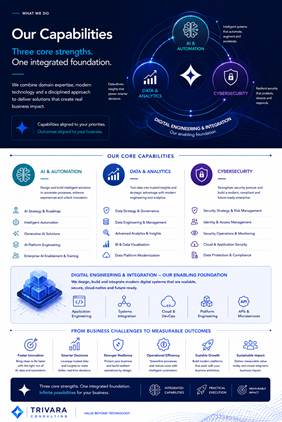
- Focus on business outcomes before technology activity.
- Build on the enterprise environment that already exists.
- Prioritise scalable, secure and measurable value creation.
One of the most valuable characteristics of enterprise datais its ability to create more value when information from different parts ofthe business can be connected responsibly.
Consider a business that analyses sales data in isolation.It may understand what was sold. But when sales data is connected with customerbehaviour, inventory, pricing, service history and profitability, theorganisation can begin answering more useful questions.
Which customer segments are genuinely profitable? Whichproducts are creating service costs that reduce margin? Which customers arelikely to churn? Where is inventory likely to become constrained? Which salesopportunities deserve greater attention? Which operational factors areaffecting customer experience?
The same principle applies across functions.
- Finance and operational data can improveprofitability analysis and forecasting
- Customer and service data can improve retentionand experience
- Supply chain and sales data can improve planningand inventory decisions
- Asset and maintenance data can improve uptimeand utilisation
- Workforce and productivity data can improvecapacity planning
- Risk, transaction and behavioural data canstrengthen early-warning indicators
The value is not simply in connecting every dataset. Theobjective is to connect the right information around decisions and processesthat matter.
A data strategy needs a business-value map
Many data programmes begin with architecture: platforms,warehouses, lakes, pipelines and tools. These capabilities are important, buttechnology alone does not tell the organisation where the highest-valueopportunity sits.
A stronger approach is to create a business-value map.
Leadership teams can identify the decisions, processes andcommercial outcomes where better data would materially improve performance.Each opportunity can then be assessed against data availability, quality,integration complexity, security requirements and expected value.
Typical areas might include:
- Customer profitability and segmentation
- Revenue forecasting and pricing
- Working-capital visibility
- Sales pipeline intelligence
- Supply-chain and demand planning
- Operational productivity
- Fraud and risk detection
- Service quality and customer retention
- Asset utilisation and predictive maintenance
- Management reporting and faster decision cycles
This approach gives technology teams a clearer reason foreach data investment and gives business leaders a clearer way to measure itsreturn.
Trivara's role in such programmes is to connect the dataconversation to the business objective - helping organisations identifyhigh-value use cases, assess the current data environment, prioritise gaps, andcreate a practical roadmap for improving data availability, integration anduse.
Trust is as important as access
Making data available is only one part of the challenge.Decision-makers also need to trust it.
If two dashboards produce different revenue numbers, ifcustomer records contain duplicates, or if key fields are incomplete, theorganisation may technically have data access without having reliable decisionsupport.
Data quality therefore becomes a business issue rather thanmerely an IT issue.
Trust depends on several factors:
- Clear ownership of important data domains
- Consistent definitions for key business metrics
- Appropriate quality checks and controls
- Traceability of where critical numbers come from
- Access controls based on role and business need
- Governance over how sensitive information isused
- Processes for correcting data problems ratherthan repeatedly working around them
A mature data environment does not mean every record isperfect. It means the organisation knows which information is critical,understands its quality, and has the governance required to use it withconfidence.
Data security must be designed into the value equation
As organisations make data more accessible andinterconnected, security becomes more important, not less.
A company can create significant operational value bybreaking down data silos, but poorly controlled access can also increaseexposure. Sensitive customer, employee, financial or operational informationshould not become broadly available simply because a modern data platform makesaccess technically possible.
This is why data, cybersecurity and business governance needto work together.
Organisations should understand who can access criticalinformation, how data is classified, where it is stored, how it moves betweensystems, what third parties can access, and what controls apply to sensitive orregulated information.
Trivara's combined focus on Data, AI and Cybersecurityallows these questions to be considered together. The objective is not merelyto make information more available. It is to make the right informationavailable to the right users and systems, with the appropriate controls.
AI is increasing the value of getting data right
The rapid adoption of AI has given enterprise data strategya new level of urgency.
AI systems are only as useful as the information they canaccess and interpret. If enterprise data is incomplete, inconsistent,inaccessible or poorly governed, AI may simply produce faster answers from weakfoundations.
Organisations therefore need to ask whether their dataenvironment is ready for AI before assuming that an AI platform will solveexisting information problems.
Important questions include:
- Can AI systems access the relevant enterpriseknowledge securely?
- Is the underlying data sufficiently accurate andcurrent?
- Are important documents and datasets structuredin a usable way?
- Can information from multiple systems becombined reliably?
- Are access rights and sensitive-data controlsclear?
- Can the organisation trace and validate theinformation behind AI-assisted decisions?
Improving these foundations creates value even before an AIprogramme begins. Better connected and governed data improves analytics,reporting and decision-making today while increasing the organisation's abilityto adopt AI tomorrow.
In this sense, data transformation is not a separateprecursor to AI. It is one of the core capabilities that determines whetherenterprise AI can move beyond experimentation.
Five questions leadership teams should be asking about data
1. Which of our data assets are actually improving business performance?
Data volume is not the same as data value. Leadership shouldknow which information materially influences revenue, cost, customer outcomes,risk or strategic decisions.
2. Where is valuable data trapped in silos?
Understanding where information is fragmented helps identifyopportunities for integration and reduces repeated manual reconciliation.
3. Where could connected data create new efficiency or revenue?
Look beyond reporting. Consider processes, customer journeysand decisions where combining information could materially improve an outcome.
4. Can we trust and secure the data we want to use?
Access, quality, ownership, privacy and cybersecurity shouldbe assessed together before information is scaled across the enterprise.
5. Is our data environment ready for the next generation of AI?
Organisations should understand whether current dataarchitecture, governance and integration can support AI safely and reliably.
From stored data to business value
The organisations that create the greatest advantage fromdata will not necessarily be those that collect the most.
They will be those that know which data matters, connect itaround valuable business decisions, improve its trustworthiness, protect itappropriately and make it accessible to the people and systems that can use it.
That is the shift from data accumulation to data value.
For some organisations, the opportunity may be directmonetisation. For many others, the larger value will come from betterdecisions, higher productivity, stronger customer insight, more efficientoperations and improved AI readiness.
Either way, the starting point is similar:
Understand what data you have. Determine where value can becreated. Connect what matters. Improve what cannot be trusted. Secure what mustbe protected. Then build the capability to use it repeatedly at scale.
How Trivara Consulting Can Help
Trivara Consulting helps organisations strengthen theconnection between enterprise data and measurable business outcomes.
Our work across Data, AI and Cybersecurity enablesorganisations to evaluate data not only as a technology asset, but as afoundation for better decisions, operational efficiency, secure digital growthand AI adoption.
Trivara can support organisations in areas such as:
- Enterprise data readiness and maturityassessment
- Data strategy aligned to business priorities
- Data monetisation and business-value opportunityidentification
- Data integration and modernisation roadmap
- Data quality, governance and ownershipframeworks
- Analytics and decision-intelligence use cases
- Data platforms and cloud data architecture
- AI-ready data foundations
- Data security, access and governanceconsiderations
Rather than beginning with a platform decision, Trivarastarts by understanding the business outcomes the organisation wants to improveand then assessing the data, systems, governance and integration capabilitiesrequired to achieve them.
Questions we're commonly asked.


Every Successful Modernization Starts with the Right Conversation.
Whether you're exploring AI, modernizing legacy systems, strengthening cybersecurity, or building a long-term capability roadmap, the right approach begins with understanding your business. Let's discuss your priorities, identify the opportunities, and define the best path forward.


